
Transient overvoltages in DC systems pose serious risks. These voltage spikes—typically caused by induced lightning surges or switching faults—can result in insulation breakdown, reverse flashover, component failure, and costly downtime. Studies show that peak lightning current, grounding resistance, and surge impedance are the major contributors to surge-induced breakdowns.
A Type 2 DC Surge Protective Device (DC SPD) plays a critical role in mitigating these risks. It clamps transient overvoltage and redirects excess energy safely to the grounding system, ensuring operational stability and equipment protection. When correctly selected and installed, it becomes one of the most cost-effective ways to enhance DC system reliability and long-term safety.
Key Takeaways
Type 2 DC SPDs protect sensitive equipment from lightning-induced surges and switching transients, ensuring stable performance.
Reduced cumulative stress extends the operational lifespan of batteries, inverters, controllers, and other DC components.
Installing Type 2 DC SPDs minimizes downtime and maintenance costs, directly improving operational efficiency.
Proper installation and coordination with upstream/downstream protection devices significantly enhance system safety and reliability.
Why Type 2 DC SPDs Are Essential for Modern DC Systems
Preventing Equipment Damage
DC systems used in solar PV arrays, BESS installations, telecom power supplies, and industrial control panels rely on sensitive electronic components. These components are highly vulnerable to transient overvoltages generated by:
Nearby lightning activity
Switching operations
Capacitive load changes
Fault-induced voltage oscillations
A Type 2 DC SPD reacts within nanoseconds to clamp overvoltage and redirect surge current into the grounding system. This ensures:
✔ Stable operation
✔ Protection of sensitive DC electronics
✔ Prevention of latent or immediate failure
✔ Avoidance of costly unscheduled repairs
By installing Type 2 SPDs downstream of the main surge protection stage, you eliminate the risk posed by residual surges that remain after a primary protection device.
Extending the Lifespan of DC Systems
Surges do not always cause immediate failure. More commonly, they generate invisible cumulative damage, gradually degrading components such as:
Battery management circuits
Inverter DC boards
IGBT modules
DC/DC converters
A Type 2 DC SPD mitigates this damage by:
Reducing voltage peaks entering equipment
Maintaining components within safe operating boundaries
Minimizing thermal stress and long-term degradation
This translates to:
✔ A longer service life
✔ Fewer repairs
✔ Lower replacement frequency
✔ Greater system stability over time
For industrial control systems, Type 2 SPDs have been proven to extend the lifespan of mission-critical components significantly.
Increasing Uptime and Enhancing Operational Safety
Downtime disrupts operations and produces financial losses. Type 2 DC SPDs minimize unplanned outages by ensuring continuous, stable operation—especially in applications requiring high availability.
They also mitigate fire and safety hazards. Uncontrolled surges can:
Ignite wiring insulation
Damage terminals
Cause flashover
Result in equipment failure that threatens personnel safety
With proper surge protection, these risks are dramatically reduced.
The result is:
✔ Improved uptime
✔ Lower maintenance cost
✔ Increased equipment safety
✔ Greater financial stability
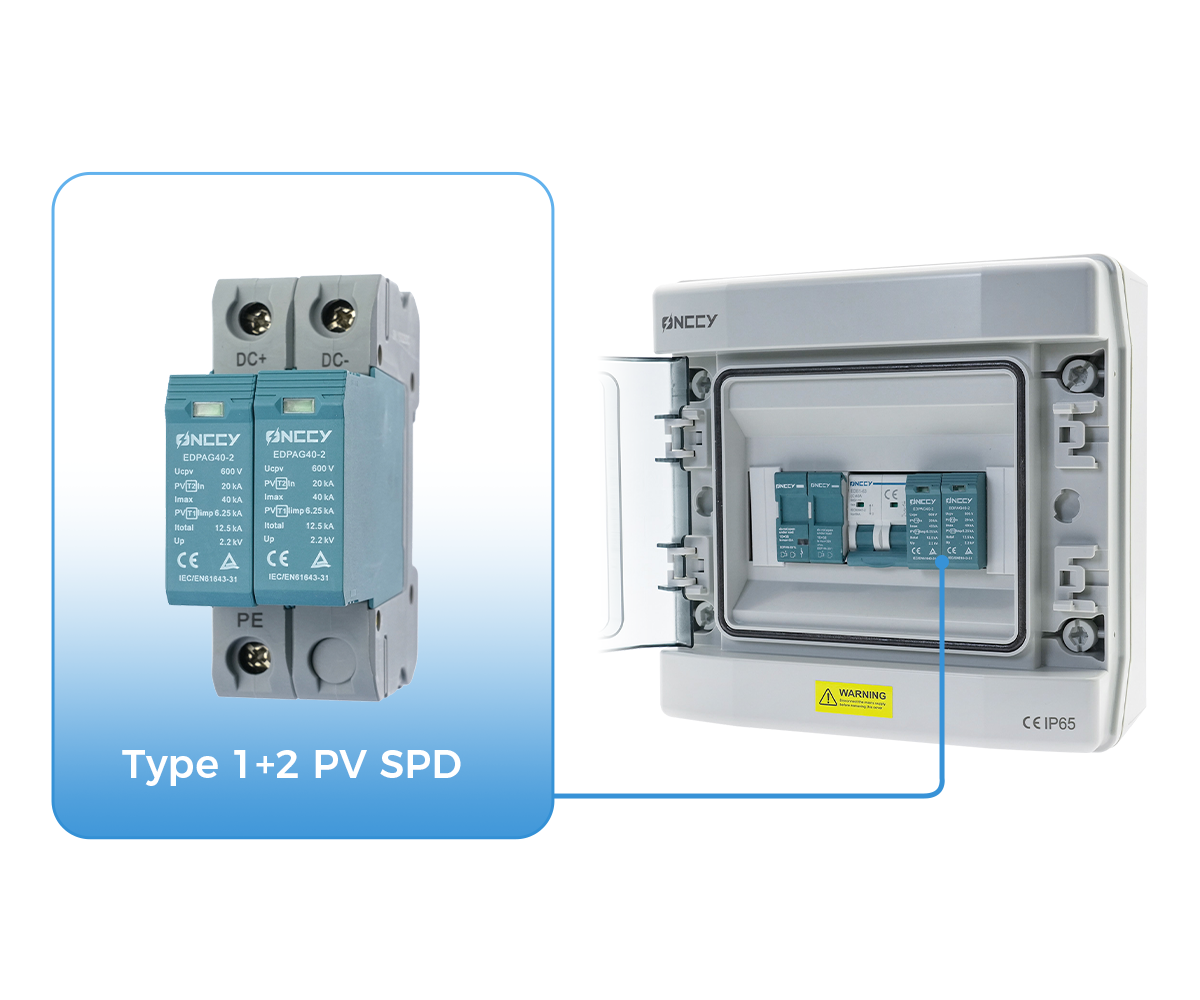
How Type 2 DC SPDs Work in DC Systems
Clamping Overvoltage and Redirecting Energy
A Type 2 DC SPD uses two key protective elements:
1. MOV (Metal Oxide Varistor)
Activates when voltage exceeds a defined threshold
Clamps voltage and diverts excess energy away from equipment
Provides fast, initial surge response
2. GDT (Gas Discharge Tube)
Activates when surge current exceeds the MOV’s clamping ability
Transfers remaining surge energy safely to ground
Handles high-energy impulses with long service life
Typical characteristics:
Response time: <25 nanoseconds
Clamping range: 12 V to 460 V (depending on DC system rating)
Effective against: indirect lightning surges & switching transients
Suitable Risk Levels and DC Environments
According to IEC 61643-11, Type 2 SPDs are suitable for medium-risk environments, including:
Urban areas
Locations with moderate lightning exposure
Systems susceptible to indirect lightning or switching surges
Not ideal for:
High-risk areas exposed to direct lightning currents
→ requires Type 1 SPD at the service entranceVery low-risk areas
→ may not need additional protection unless equipment is sensitive
Comparison with Other Surge Protection Methods
| Protection Type | Purpose | Strengths | Limitations |
|---|---|---|---|
| Type 1 SPD | Primary protection | Handles high-energy lightning currents | Not suitable for equipment-level protection |
| Type 2 SPD | Secondary protection | Protects downstream equipment from residual/transient surges | Not designed for direct lightning currents |
| Type 3 SPD | Terminal/device protection | Excellent for sensitive loads | Only works when coordinated with Type 1/2 |
Type 2 SPDs are essential as the middle layer—the most important layer for equipment performance and reliability.
Performance Indicators That Define Reliability
Voltage Protection Level (VPL) & MCOV
Key parameters include:
MCOV (Maximum Continuous Operating Voltage)
Up (Voltage Protection Level)
In (Nominal discharge current, 1–20 kA)
Imax (Maximum discharge current, typically 2 × In)
Matching these values to your system ensures proper protection without nuisance tripping.
Durability and Failure Modes
Different components have different long-term behaviors:
| Component | Lifespan | Degradation Mechanism |
|---|---|---|
| GDT | Very long | Slight electrode wear, minor voltage shift |
| MOV | Medium | Gradual leakage current increase after each surge |
| TVS / Avalanche Diode | Long | Stable unless severely overloaded |
High-quality Type 2 SPDs integrate:
Thermal disconnectors
Self-resetting mechanisms
Visual/remote failure indicators
These reduce maintenance labor and increase operational reliability.
Standards and Certifications
A compliant Type 2 DC SPD should meet:
IEC/EN 61643-11
GB/T 18802.11
Certification ensures the device can withstand real surge stresses and operate safely throughout its lifespan.
Installation Strategy for Type 2 DC SPDs
Where to Install
Installation depends on DC cable length and equipment sensitivity:
| Cable Length | Equipment Type | Upstream SPD? | Device-Side SPD? | Recommendation |
|---|---|---|---|---|
| <10 m | Standard | Yes | Optional | Enhanced protection but not mandatory |
| <10 m | Standard | No | Mandatory | No upstream protection → must add Type 2 SPD |
| <10 m | Sensitive | Any | Strongly recommended | Protects high-value electronics |
| >10 m | Any | Any | Mandatory | Long cable acts as surge antenna |
| >10 m | Sensitive | Any | Mandatory | Long cable + sensitive load → must protect |
Coordination with Upstream and Downstream Devices
Effective surge protection requires:
Coordinated Type 1 + Type 2 + Type 3 stages
Short lead length (<30 cm recommended)
Proper conductor cross-section
Electrical separation or inductance between stages
Safety Best Practices
Avoid the following common installation mistakes:
| Mistake | Risk |
|---|---|
| SPD incorrectly sized | Surge bypasses protection |
| No cascade system | High-energy surges reach sensitive devices |
| Poor grounding or equipotential bonding | Higher risk of flashover & equipment failure |
Economic Value: Lower Maintenance Cost & Higher ROI
Reducing Downtime and Maintenance
Type 2 DC SPDs:
Reduce unplanned outages
Protect revenue-generating systems
Lower long-term labor & maintenance cost
Applications benefiting significantly:
Solar PV strings
BESS (battery energy storage systems)
EV charging DC systems
Telecom DC power
Industrial DC control networks
Long-Term Return on Investment
Organizations installing Type 2 DC SPDs see:
Fewer equipment failures
Lower insurance claims
Extended equipment lifetime
Greater system stability
Higher overall ROI
This makes Type 2 SPDs a low-cost, high-impact investment.
Conclusion: A Smarter, Safer, More Reliable DC System Starts with Type 2 Surge Protection
A Type 2 DC SPD is essential for every modern DC system.
It ensures:
✔ Protection of sensitive electronics
✔ Longer system lifespan
✔ Higher uptime and operational stability
✔ Reduced maintenance and downtime cost
✔ A safer environment for people and assets