
What an MCCB really does
An MCCB (molded case circuit breaker) is a low-voltage, air-insulated protective device used in distribution to switch, isolate, and interrupt fault currents within its rated limits—protecting cables, switchboards, and downstream equipment.
What often confuses buyers is that “an MCCB is not just about current rating.” Real-world reliability depends on trip technology, breaking capacity, system voltage, installation space, and how faults behave in your network.
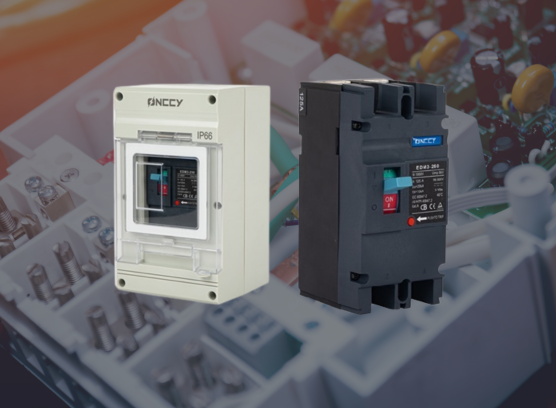
Pain Points: Why MCCB selection fails in projects
Most MCCB issues in the field come from five predictable mistakes:
Frame size is mistaken for usable current → nuisance trips or overheating.
Voltage assumptions (using a 380/400V breaker on higher systems) → insulation risk.
Breaking capacity under-matched to available fault current → unsafe interruption.
Accessories ignored until commissioning → no remote trip, no status feedback, no interlocks.
No consideration of arcing distance inside panels → flashover between phases or to grounded metal.
3) Core Technology: Trip units and interruption capability
Trip unit types (how the MCCB decides to trip)
Common trip methods you’ll encounter:
Magnetic-only trip (Instantaneous)
Trips only on short-circuit faults.
Often used in heater circuits or motor circuits where overload protection is handled elsewhere.
Thermal-magnetic trip (Thermal + Instantaneous)
Trips on overload (long-time) and short-circuit (instantaneous).
The most common choice for general distribution.
Electronic trip
Allows adjustable long-time (overload), short-time, instantaneous, and sometimes ground fault.
Wider application coverage, better coordination—but higher cost.
Motor-protection breaker (special motor curve)
Magnetic trip is commonly set ≥10× In to ride through motor inrush.
Used specifically to avoid tripping during motor start while still protecting against faults.
Icu vs Ics (breaking capacity that actually matters)
Icu (Ultimate breaking capacity): breaker can interrupt under test conditions, but may not remain serviceable afterwards.
Ics (Service breaking capacity): breaker interrupts and is expected to continue carrying rated current after the test.
In engineering terms: Ics is your “usable” breaking performance, especially where reliability and continuity matter.
4) Selection in Practice: The 5 must-check parameters
Factor 1 — Frame rating vs rated current (In)
Frame size (frame rating) is the maximum trip unit current that can fit in the same physical case.
Rated current (In) is what the installed trip unit can carry continuously.
Best practice: Specify the MCCB model completely (frame + In), not “just 250A breaker.”
Factor 2 — Rated insulation voltage (Ui) and operating voltage (Ue)
Ui drives insulation design (clearances/creepage).
Ue is the rated working voltage the breaker is designed to switch/protect at.
Rule of thumb: Never apply an MCCB to a system voltage beyond its rated working voltage, even if “it seems close.”
Factor 3 — Short-circuit breaking capacity (Icu / Ics)
Match the MCCB’s breaking capacity to your prospective short-circuit current at the installation point.
Avoid waste: Don’t add unnecessary “safety margins” that push you into a much higher Icu/Ics class unless your fault study requires it.
Factor 4 — Accessories (control + monitoring + automation readiness)
Accessories turn an MCCB from a “manual protector” into a “system component.” Common ones:
Auxiliary contact: indicates ON/OFF position (status display).
Alarm contact: indicates fault trip (overload/short/undervoltage trip event).
Shunt trip: remote open command (short-duty coil; don’t energize too long).
Undervoltage release: prevents closing or trips when supply drops below threshold.
Motor operator / operating mechanism: remote closing/opening for automation.
External rotary handle: door coupling for switchboards.
Selection tip: Decide accessories early—panel wiring, door design, and control power depend on them.
Factor 5 — Arcing distance (clearance for “arc blowout”)
During high fault interruption, arcs and ionized gas may eject from vents. If clearance is insufficient, you can get phase-to-phase flashover or phase-to-ground faults inside the enclosure.
Practical guidance:
Verify the manufacturer’s required arcing distance / arc vent clearance.
If panel space is tight, choose MCCBs designed for reduced or zero arcing distance (when available) to improve safety.
Quick Checklist (use this on every MCCB inquiry)
What is the system voltage and frequency (Ue requirement)?
What is the continuous load current (In) and ambient temperature?
What is the available fault current at the point of installation (Icu/Ics)?
Which trip unit is needed (magnetic-only / thermal-magnetic / electronic / motor curve)?
Which accessories are required (aux, alarm, shunt, UVR, motor operator)?
What is the panel clearance and required arcing distance?
5) Brand Note: Why ONCCY fits PV and LV protection projects
ONCCY is a manufacturer of photovoltaic protection components and low-voltage protection devices, supporting OEM/ODM programs. If your project requires consistent coordination across PV combiner boxes, distribution cabinets, and protection chains, working with a supplier who understands trip behavior, coordination needs, and panel safety constraints reduces redesign and commissioning risk.
FAQs
1) How do I choose between thermal-magnetic and electronic trip MCCBs?
Thermal-magnetic fits standard distribution with fixed protection needs. Electronic trip is better when you need adjustable settings, selectivity/coordination, or multiple protection functions.
2) Is frame rating the same as breaker rated current (In)?
No. Frame rating is the maximum capacity of the case platform. In is the installed trip unit’s continuous current rating.
3) Which breaking capacity matters more, Icu or Ics?
Ics matters more for service continuity because it reflects interruption where the breaker should remain operational afterward.
4) What’s the risk of ignoring arcing distance?
Arc or ionized gas ejection can cause internal flashover, creating secondary faults inside the panel—especially in compact enclosures.
5) Can I use a standard MCCB for motor circuits?
Sometimes, but motor circuits often need higher instantaneous settings (or dedicated motor-protection breakers) to avoid tripping on inrush current.