
As global solar capacity continues to grow, photovoltaic system safety, reliability, and energy efficiency have become increasingly important. Although solar panels and inverters often receive the most attention, the DC combiner box also plays a critical role in the overall performance of a PV installation.
A properly selected solar combiner box consolidates multiple PV strings into one output while providing circuit protection, surge protection, and a convenient isolation point. This article explains the functions, specifications, safety features, and typical applications of the ONCCY 1000V 63A IP65 DC solar combiner box.
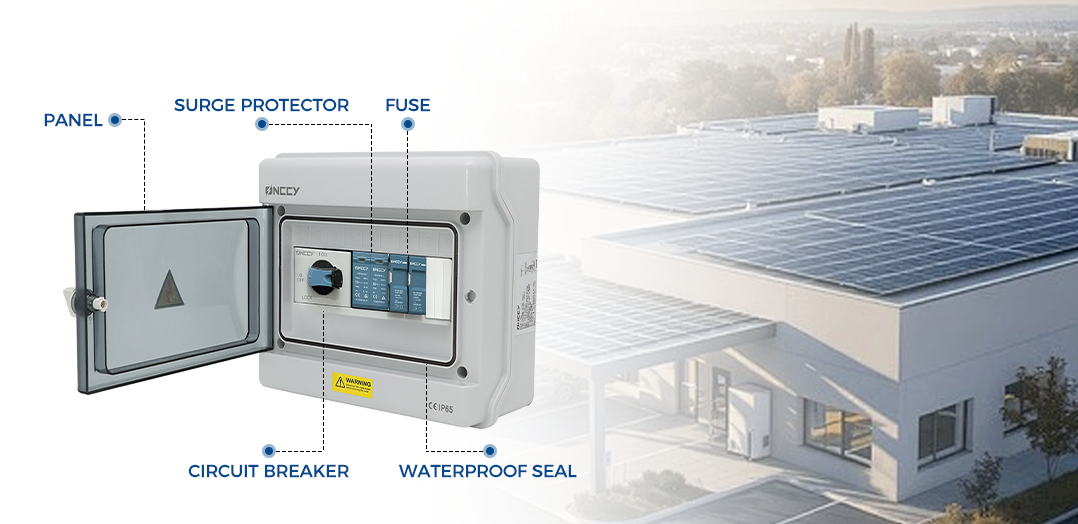
What Is a DC Solar Combiner Box?
A DC solar combiner box is an electrical enclosure used to connect multiple photovoltaic strings in parallel.
Solar modules are first connected in series to create PV strings. The positive and negative conductors from these strings are then connected to individual input circuits inside the combiner box. After passing through the appropriate protective devices, the combined DC power is delivered to the inverter through a single output circuit.
This arrangement can help:
Reduce the number and length of cables running to the inverter
Simplify PV array wiring
Protect individual solar strings
Provide surge protection on the DC side
Make inspection, isolation, and maintenance more convenient
The combiner box does not increase the power generated by the solar modules. Its purpose is to organize, combine, and protect the DC circuits before power reaches the inverter.
Key Specifications
| Specification | Value |
|---|---|
| Maximum system voltage | 1000V DC |
| Rated output current | 63A |
| Enclosure protection | IP65 |
| Operating temperature | -40°C to +65°C |
| Enclosure material | Flame-retardant, UV-resistant PC+ABS |
| Typical configurations | 2-in/1-out, 4-in/1-out, and 6-in/1-out |
| Application | DC side of photovoltaic systems |
Final specifications should always be confirmed against the selected product configuration and project documentation.
Four Key Product Advantages
1. IP65 Protection for Outdoor Installations
An IP65 enclosure is designed to prevent dust from entering and to protect internal components against low-pressure water jets from different directions. This makes the combiner box suitable for many outdoor PV installations, including rooftops, ground-mounted arrays, carports, and agricultural solar projects.
The PC+ABS enclosure is designed to offer:
Flame-retardant performance
Resistance to impact
Resistance to ultraviolet exposure
Protection against dust and moisture
Reliable performance across a wide temperature range
IP65 protection does not mean the enclosure can be submerged in water. Installers must also use suitable cable glands, seals, and mounting practices to maintain the specified protection level.
2. Support for PV Systems up to 1000V DC
High-voltage DC architectures are widely used in modern photovoltaic installations because they can reduce current for a given power level and support longer strings.
This combiner box is designed for systems operating at up to 1000V DC, making it suitable for many commercial, industrial, rooftop, and ground-mounted solar applications.
The actual maximum DC voltage of a PV string must be calculated using the module open-circuit voltage and the lowest expected site temperature. The resulting value must remain below the voltage ratings of the combiner box, inverter, connectors, cables, fuses, surge protective devices, and other components.
3. 63A Output with Flexible Input Options
With a rated output current of 63A, the combiner box can consolidate several PV strings into one DC output. Available configurations may include:
2 inputs and 1 output
4 inputs and 1 output
6 inputs and 1 output
Project-specific customized configurations
Each input circuit can be equipped with independent protection, helping isolate a fault without unnecessarily affecting healthy strings.
The correct configuration depends on the number of strings, maximum string current, expected reverse current, cable capacity, inverter input limits, and applicable electrical requirements. The 63A rating should not be treated as the automatic operating current for every project.
4. Multiple Layers of DC Protection
PV arrays can be exposed to short circuits, reverse currents, switching surges, and lightning-induced transient overvoltages. A properly configured combiner box provides several complementary layers of protection.
String Overcurrent Protection
Each PV string can be fitted with DC-rated fuses. If excessive reverse current or a short-circuit condition occurs, the appropriate fuse can disconnect the affected circuit.
Fuse selection should be based on:
Module short-circuit current
Maximum series fuse rating specified by the module manufacturer
Number of strings connected in parallel
Conductor current-carrying capacity
Local design and installation requirements
DC Surge Protection
A photovoltaic surge protective device can help limit transient overvoltages caused by nearby lightning activity or electrical switching events.
Protection may be provided between:
Positive and earth
Negative and earth
Positive and negative
Effective surge protection also depends on correct earthing, short connection paths, conductor routing, and coordination with other protective devices in the PV system.
Output Circuit Protection
A DC-rated circuit breaker provides switching and protection at the combined output. It allows the downstream circuit to be disconnected during certain fault conditions or planned maintenance.
Only devices specifically rated for the system’s DC voltage, current, and polarity arrangement should be used. AC breakers must not be substituted for properly rated DC protective devices.
Typical Applications
Ground-Mounted Solar Power Plants
Multiple PV strings can be combined closer to the array, reducing the number of long cable runs to the inverter and improving wiring organization.
Commercial and Industrial Rooftops
The compact enclosure and outdoor protection make the combiner box suitable for many commercial rooftop installations where space and environmental exposure must be considered.
Distributed Solar Systems
Flexible input configurations allow designers to match the combiner box to different array sizes and inverter layouts.
Solar Carports and Agricultural PV Projects
UV-resistant materials and a broad operating temperature range support installations exposed to changing outdoor conditions.
How to Select the Right PV Combiner Box
A combiner box should be selected as part of the complete system design rather than as an isolated component. Before purchasing, verify the following:
Maximum DC system voltage: Include the increase in module open-circuit voltage at low temperatures.
Number of PV strings: Match the number of protected inputs to the array layout.
Maximum current: Calculate both normal operating current and possible fault or reverse-current conditions.
Fuse ratings: Follow the PV module manufacturer’s maximum series fuse specification.
Inverter compatibility: Confirm voltage, current, MPPT, and input-circuit requirements.
Surge protection design: Select the appropriate SPD type and voltage rating for the project.
Environmental conditions: Consider temperature, UV exposure, dust, humidity, and installation location.
Cable and connector ratings: Ensure that every part of the DC circuit is rated for the maximum system voltage and current.
Compliance documentation: Confirm applicable product certificates, test reports, and project-specific regulatory requirements with the supplier.
Installation and maintenance should be performed by qualified photovoltaic or electrical professionals in accordance with the product manual and applicable local standards.
Why Choose an ONCCY DC Combiner Box?
The ONCCY 1000V 63A IP65 DC combiner box is designed to provide a practical combination of electrical protection, outdoor durability, and configuration flexibility.
Key benefits include:
Photovoltaic-specific protective components
IP65 dust and water protection
Flame-retardant and UV-resistant enclosure material
Multiple input configurations
Compact and installation-friendly design
Customization options for project requirements
Technical support and warranty service
Where IEC, TÜV, or other compliance requirements apply, buyers should request the certificates and technical documentation for the exact model and configuration being ordered. Certification should be verified at the product level rather than assumed from individual internal components.
Conclusion
A DC combiner box is a small but essential part of many photovoltaic systems. By consolidating multiple strings and integrating overcurrent, surge, and output protection, it can simplify wiring and contribute to safer, more maintainable PV installations.
With a maximum system voltage of 1000V DC, a rated output current of 63A, an IP65 enclosure, and flexible input options, the ONCCY DC solar combiner box is suitable for a wide range of rooftop, commercial, industrial, and ground-mounted solar projects.
For reliable operation, the final product configuration must be selected according to the PV module data, inverter requirements, site conditions, system calculations, and applicable electrical standards.